


Is cold heading and cold extrusion the same thing, and what is the difference between the two?
Cold heading and cold extrusion are basically deformation processing under the same conditions, but their operating methods are different. Cold blocks belong to the forging deformation of smaller workpieces and are commonly used in the fastener industry. Cold extrusion, on the other hand, belongs to the deformation of larger workpieces and is widely used.
01 What is cold extrusion
Cold extrusion is a processing method that places a metal blank in the cold extrusion die cavity and applies pressure to the blank through a fixed convex die on a press at room temperature, causing plastic deformation of the metal blank and producing parts. Obviously, cold extrusion processing relies on the mold to control the flow of metal and the transfer of a large amount of metal volume to form parts.
If the blank is extruded without heating, it is called cold extrusion. Cold extrusion is one of the advanced processing methods in metal chip plastic processing, as it is one of the processes for machining parts with no or few chips. If the blank is heated to a temperature below the recrystallization temperature for extrusion, it is called warm extrusion. Warm extrusion still has the advantage of less and no chips.
Cold extrusion technology is an advanced production process technology with high precision, efficiency, quality, and low consumption, which is widely used in the large-scale production of small and medium-sized forgings. Compared with hot forging and warm forging processes, it can save 30% to 50% of materials, save 40% to 80% of energy, and improve the quality of forgings and the working environment.
At present, cold extrusion technology has been widely applied in industrial sectors such as fasteners, machinery, instruments, electrical appliances, light industry, aerospace, shipbuilding, and military industry, and has become an indispensable and important processing method in metal plastic volume forming technology. With the advancement of technology and the continuous improvement of product technology requirements in industries such as automobiles, motorcycles, and household appliances, cold extrusion production technology has gradually become the development direction of precision production of small and medium-sized forgings.
Cold extrusion can also be divided into forward extrusion, reverse extrusion, composite extrusion, radial extrusion, etc.
02 What is Cold Heading
Cold heading process is one of the few new non cutting metal pressure processing techniques. It is a processing method that utilizes the plastic deformation of metal under external forces, and with the help of molds, redistributes and transfers the volume of metal to form the required parts or blanks. The cold heading process is most suitable for producing standard fasteners such as bolts, screws, nuts, rivets, and pins. The commonly used equipment for cold heading technology is a dedicated cold heading machine. If the production volume is not too large, a crank press or friction press can also be used as a substitute.
Cold heading technology is increasingly widely used in mechanical manufacturing, especially in the production of standard fasteners, due to its high productivity, good product quality, and significant reduction in material consumption, production costs, and improved labor conditions. Among them, the most representative products produced by multi station cold heading machines are bolts, screws, and nuts.
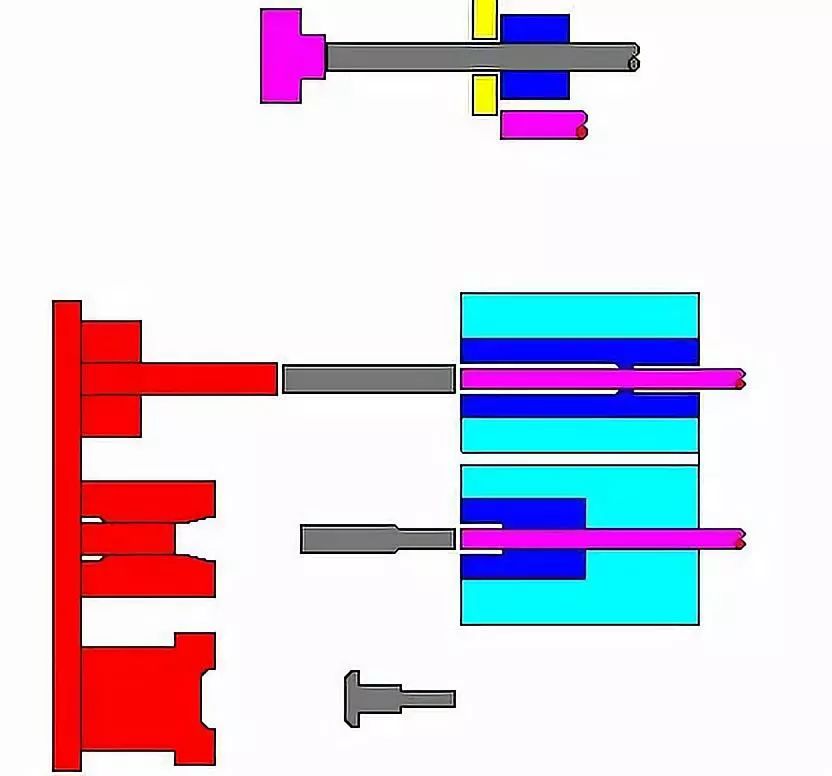
Is cold heading and cold extrusion the same thing?
Cold pier and cold extrusion are basically deformation processing under the same conditions, but their operating methods are different. Cold blocks belong to the forging deformation of smaller workpieces and are commonly used in the fastener industry. Cold extrusion, on the other hand, belongs to the deformation of larger workpieces and is widely used; Cold heading is equivalent to a branch of cold extrusion. Simply put, in the process of making bolts, the hexagonal head forming belongs to cold heading, and the rod diameter reduction belongs to cold extrusion (forward extrusion). Non cut hexagonal flange bolts (multi station forming) have both cold heading and cold extrusion. Before forming the hexagonal nut, only cold heading is used for shaping, while the subsequent process of hole extrusion belongs to cold extrusion (forward and reverse extrusion).


