


What is plug milling? What are the uses in processing?
Plunge milling, also known as Z-axis milling, is one of the most effective machining methods for achieving high cutting rate metal cutting. For surface machining, groove cutting, and machining with large tool overhang for difficult to machine materials, the machining efficiency of the insert milling method is much higher than that of the conventional end face milling method. In fact, when it is necessary to quickly cut off a large amount of metal materials, using the insertion milling method can shorten the processing time by more than half.
Advantages
In addition, slot milling also has the following advantages:
① Can reduce workpiece deformation; ② It can reduce the radial cutting force acting on the milling machine, which means that the worn spindle can still be used for insertion milling without affecting the machining quality of the workpiece; ③ The overhanging length of the cutting tool is relatively long, which is very beneficial for milling the groove or surface of the workpiece; ④ Able to achieve groove cutting for high-temperature alloy materials (such as Inconel). The insertion milling method is very suitable for rough machining of mold cavities and is recommended for efficient machining of aviation components. One special purpose is to insert and mill turbine blades on three-axis or four-axis milling machines, which usually requires specialized machine tools.
Working principle
When milling turbine blades, it is possible to mill from the top of the workpiece all the way down to the root of the workpiece. By simply translating the X-Y plane, extremely complex surface geometries can be machined. When implementing insertion milling, the cutting edge of the milling cutter is formed by overlapping the profiles of each blade, and the insertion milling depth can reach 250mm without vibration or distortion deformation. The cutting direction of the tool relative to the workpiece can be either downward or upward, but downward cutting is generally more common. When milling inclined surfaces, the milling cutter moves in a compound motion along the Z-axis and X-axis directions. In certain machining situations, spherical milling cutters, face milling cutters, or other milling cutters can also be used for milling grooves, milling profiles, milling slopes, milling cavities, and other types of machining.
Applicable scope
Special insert milling cutters are mainly used for rough or semi precision machining. They can cut into the concave part of the workpiece or cut along the edge of the workpiece, as well as milling complex geometric shapes, including root digging. To ensure a constant cutting temperature, all shank milling cutters adopt internal cooling method. The design of the cutting body and blade of the milling cutter allows it to cut into the workpiece at the optimal angle. Typically, the cutting edge angle of the milling cutter is 87 ° or 90 °, and the feed rate range is 0.08~0.25mm/tooth. The number of blades clamped on each milling cutter depends on the milling cutter diameter, for example, one diameter φ A 20mm milling cutter can install 2 blades, while a diameter f125mm milling cutter can install 8 blades. To determine whether the machining of a certain workpiece is suitable for using the insertion milling method, the requirements of the machining task and the characteristics of the machining machine used should be mainly considered. If the machining task requires a high metal removal rate, using the insertion milling method can significantly shorten the machining time.
Another suitable scenario for using the insert milling method is when the machining task requires a larger axial length of the tool (such as milling large cavities or deep grooves). Due to the effective reduction of radial cutting force by using the insert milling method, it has higher machining stability compared to the side milling method. In addition, when the parts that need to be cut on the workpiece are difficult to reach using conventional milling methods, the insertion milling method can also be considered. As the insertion milling cutter can cut metal upwards, it can mill out complex geometric shapes.
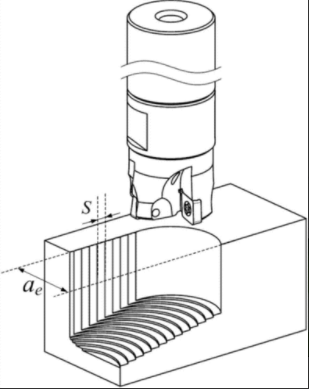
From the perspective of machine tool applicability, if the power of the machining machine tool used is limited, the insertion milling method can be considered. This is because the power required for insertion milling is smaller than that for spiral milling, so it is possible to use old or low-power machine tools to achieve higher machining efficiency. For example, deep groove milling can be achieved on a 40 level machine tool, but this type of machine tool is not suitable for using a long edge spiral milling cutter for processing, because the radial cutting force generated by spiral milling is relatively large, which can easily cause vibration of the spiral milling cutter.
Due to the low radial cutting force during insertion milling, it is very suitable for use in old-fashioned machine tools with worn spindle bearings. The insertion milling method is mainly used for rough or semi precision machining, and the small axial deviation caused by the wear of the machine tool shaft system will not have a significant impact on the machining quality. As a new type of CNC machining method, the insertion milling method has put forward new requirements for CNC machining software.


