


Surface milling cutter speed and feed rate
Basic knowledge of surface milling
What is face milling? Imagine milling with the side of an end mill. Its general term is "peripheral milling". Now, what if we cut from the bottom?
Technically speaking, this is face milling, although we usually only refer to it as face milling when using special milling cutters called "face mills" or "sleeve mills". Please note that there is actually no difference between face milling cutters and sleeve milling cutters.
You may also hear that 'face milling' is referred to as' surface milling '.
Let's first choose the type of milling cutter that best suits your milling needs. The biggest difference between face milling cutters is:
Tool diameter: Face milling cutters come in two sizes: large tool diameter and small tool diameter. Determine the tool diameter to ensure that the cutting speed (feed rate), spindle speed, and cutting horsepower requirements are within the capabilities of your machine. If the maximum cutting diameter of the tool is greater than the area you are facing, you will achieve the best smoothness. However, larger milling cutters require stronger spindles and are not always suitable for narrower areas.
Number of blades: The more blades there are, the more cutting edges there are, and the faster the feed rate of the face milling cutter. A higher cutting speed means that the work can be completed faster. A face milling cutter with only one blade is called a flying cutter. But faster is not always better. Unless you can adjust the individual heights of all blades, your multi cutting edge milling cutter will not achieve a smooth finish like a single blade flying cutter. Generally speaking, the larger the diameter of the tool, the more blades there will be.
Geometric shape: This depends on the shape of the blade and the way it is fixed in the face milling cutter.
Let's take a closer look at this geometric problem.
Choosing the best face milling cutter: 45 degrees or 90 degrees?
Firstly, what are we talking about when we say 45 degrees or 90 degrees? From the comparison of the photos of the two milling cutters above, the answer is quite clear. It is to check the angle of the cutting edge on the blade.
This angle is the angle of the cutting edge, with the left tool at 45 degrees and the right tool at 90 degrees. This angle is also known as the lead angle of the tool.
The following are the optimal operating ranges for different shell milling cutter geometries:
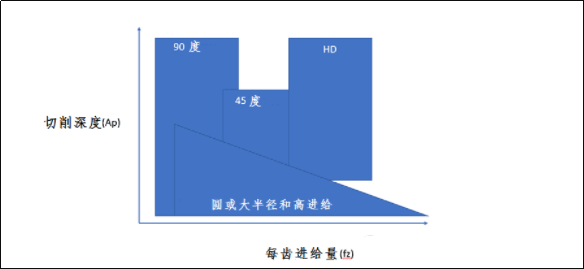
By the way, circular blade milling cutters are also known as "button milling cutters".
So which one can provide better results for surface milling machining?
Of course, it would be great if you could afford to have both 45 degree and 90 degree milling cutters at the same time, but what are the advantages and disadvantages of these two milling tools?
Advantages and disadvantages of 45 degree milling cutters
advantage:
Both Sandvik and Kennametal have stated that a 45 degree milling cutter is a better choice for general face milling. The reasons given by these two companies for choosing option 45 are:
·The cutting force is better balanced, so the axial force and radial force are roughly uniform. Reducing the radial force to make it more balanced with the axial force can not only improve the surface smoothness, but also be more beneficial for the spindle bearings.
·The performance of entry and exit is better - the impact is smaller, and the trend of breakthrough is smaller.
·A 45 degree cutting edge is more suitable for cutting with high requirements.
·Better surface finish -45 has significantly better finish. Lower vibration, balanced force, and better inlet geometry are three reasons.
·The chip thinning effect plays a role and leads to higher feed rates. Higher cutting speed means higher material removal rate and faster completion of work.
45 degree milling cutters also have some drawbacks:
·The maximum cutting depth has been reduced due to the lead angle.
·A larger diameter may cause clearance issues.
·90 degree angle milling or square shoulder milling is not allowed
·May cause breakage or burrs on the exit side of the tool during rotation.
·The lateral (axial) force applied at 90 degrees is relatively small, about half. This has advantages in terms of thin walls, as transferring excessive force to the wall can cause material vibration and other issues. When it is difficult or even impossible to firmly fix the parts in the fixture, this may also be an advantage.
To avoid forgetting about face mills, they combine some of the advantages of each type of face mill, and they are also the strongest. Therefore, if you have to deal with difficult to machine materials, milling may be your best choice.
If you are primarily pursuing perfect results, then you may need a flying knife. In most cases, flying knives can provide the best surface effect. By the way, you only need one cutting edge to easily convert any face milling cutter into a fine flying cutter.
No Information


