


How much do you know about the knife handle interface BT/BBT/HSK?
Today, I will share with you an article about the knife handle interface (BT/BBT/HSK)
The tool holder is a tool that connects the cutting tool to the machine tool, and its function is to serve as an interface between the cutting tool and the machine tool.
The performance of the tool holder directly affects the machining accuracy. In order to fully demonstrate the performance of machine tools and cutting tools, the tool holder must have jumping accuracy, stiffness (anti deformation), and high clamping force. Even if the spindle rotates at high speed, the tool holder must meet these requirements without being affected by centrifugal or other external forces. Bounce accuracy measures the degree to which a tool's rotation deviates from the center axis of the tool. The higher the jumping accuracy, the smaller the tool shake and the higher the machining accuracy.
The handle is defined by standards based on shape and size. The machining centers include BT, BBT, HSK, etc., while lathes, turning centers, and multi task machines based on lathes have CAPTO interfaces (exclusive to Sandvik).
1.
Regarding the interface of BT tool handle
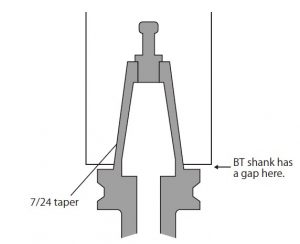
BT stands for "Morse taper" and is marked with a tapered handle. It is used by connecting it to the spindle of the machining center. The BT handle was initially developed in Japan and widely used in manufacturing sites around the world.
The size of the taper is fixed, with a 7/24 taper, where the diameter is 7mm smaller in the axial direction of 24mm. According to the diameter length of the largest part of the taper, there are nominal numbers such as BT30, BT40, and BT50.
DIN2080 NT taper shank, with a taper of 7/24, is an old-fashioned machine tool used for manual tool changing. The taper standard is the same as other 7/24 taper shanks.
2.
About the interface of BBT tool handle
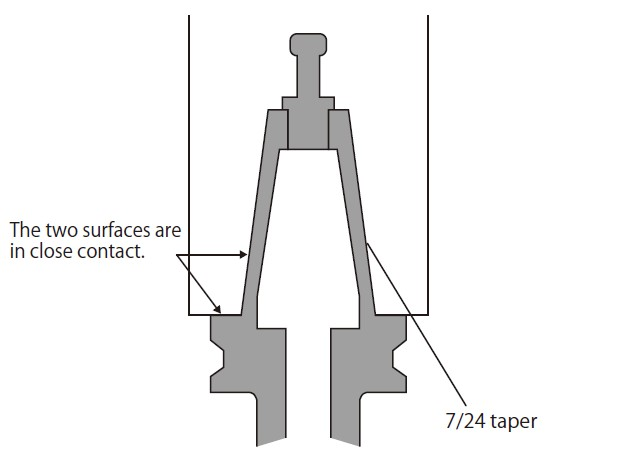
BBT knife handle is a standard developed independently by Japanese knife handle manufacturer OhShowa. At first glance, it is difficult to distinguish between BBT handle and BT handle, but the biggest difference is that BBT handle is a dual contact spindle system. "Double contact" refers to the simultaneous contact of the handle with the spindle taper and spindle surface.
For the BT handle, only the conical handle is in close contact with the spindle, and there is a gap between the handle end face and the spindle end face. In this case, when the spindle rotates at high speed, the spindle hole becomes larger due to centrifugal force, causing the tool holder to be pulled into the spindle hole, which can change the position of the tool and potentially have a negative impact on machining accuracy, especially in the Z-axis direction.
On the other hand, for BBT handles, the handle end face is in close contact with the spindle end face, so the handle will not be pulled into the spindle hole and can be processed with high precision even at high spindle speeds. Due to the close contact between the two surfaces, the BBT handle is harder than the BT handle and can control vibration during the machining process. The BBT handle can also be interchanged with the BT handle, making it easy to use.
PS: This is just a distinguishing description between BT and BBT tool holders. Compared to BBT tool holders, BT interface tool holders are much more versatile.
3.
Regarding the interface of HSK tool holder
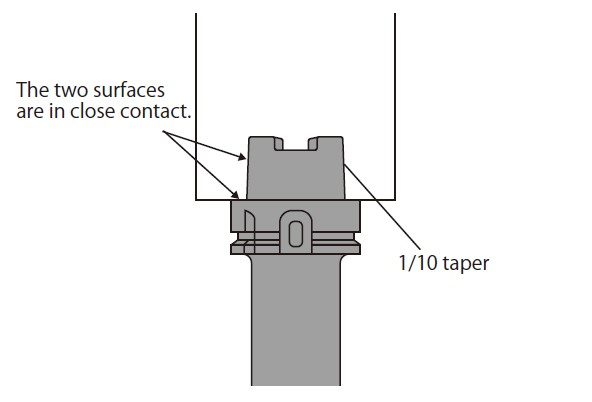
HSK is a tool holder standard developed in Germany for high-speed rotation. HSK stands for "Hohlsch ä fte Kegel" in German, meaning hollow shank.
The HSK handle has a shorter overall support length and a hollow internal structure, which is lightweight to support high-speed spindle rotation. The size of the taper is fixed and uses a 1/10 taper, with a diameter 1mm shorter than 10mm in the axial direction. Due to the dual contact system where the conical components and the end face of the handle are in close contact with the spindle, it provides high stiffness. It also specifies the size of the handle and uses six main types: 25, 32, 40, 50, 63, and 100. The smaller the number, the smaller the size of the handle.


