What are the requirements for cutting tools and tool holders in high-speed milling?
High speed cutting (HSM) is an important technology widely used in modern milling technology. By applying HSM milling technology, not only can various soft and hard materials be milled, but also excellent workpiece accuracy can be achieved. This article introduces the requirements of HSM for cutting tools and tool holders.
1, HSM's requirements for cutting tools
1. Geometric shape
Tool vibration directly affects the surface quality obtained during machining. Therefore, it is extremely important to maintain a uniform cutting force on the tool during HSM precision machining to avoid causing tool vibration.
The influence of adjacent geometric characteristics of cutting tools on cutting force:
1) Good concentricity is conducive to uniform distribution of load on the cutting edge;
2) A larger overlap of cutting edges is beneficial for obtaining uniform cutting force characteristics (larger helix angle and number of grooves);
3) Short cutting length is beneficial for obtaining better rigidity (relative to the steep wall of the machine tool, the diameter of the shaft is reduced slightly);
4) The cross-sectional state of the core is the best, and the stress concentration at the groove is the smallest.
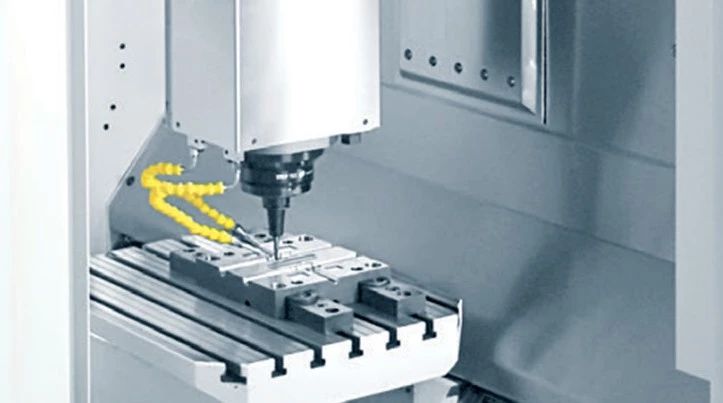
HSM can be used to process high-strength materials, which means that the resistance to deformation increases with the increase of the hardness of the material to be processed. The increase in load on the cutting edge requires a stable design of the geometric shape of the cutting edge. However, under high-speed cutting conditions, more frictional heat will be generated in the free area of the workpiece surface, which means that the clearance angle of the tool must be reduced. Therefore, increasing the stability of the cutting edge can only be achieved by reducing the slope angle. In cases where the material is very hard and the tool material is brittle, it may even result in negative angles.
The precisely matched radius is ground at the tip of the cutting edge to avoid reaching a red hot state or local fracture of the cutting edge when suddenly heated.
If high precision is required for the shape of the workpiece to be processed, the spherical radius of the precision machining tool used has a direct impact on the shape accuracy of the workpiece to be processed. Therefore, as a basic condition, it is very important to use tools with very strict radius tolerances (within the micrometer range) in the precision machining process of very precision parts.
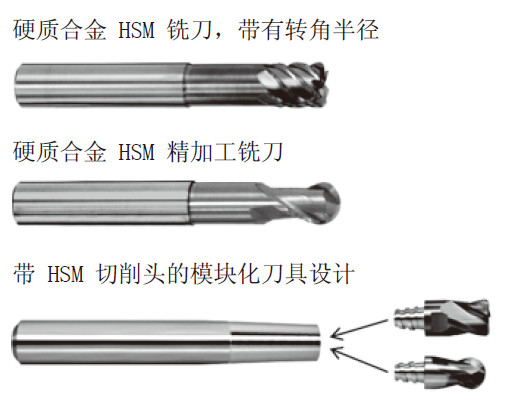
2. Materials and coatings
The tool material must be harder than the material to be processed. The greater the hardness difference between the workpiece material and the tool material, the smaller the tool wear, and the longer the tool service life. Because the local temperature is very high, it is also necessary to ensure that the tool material has antioxidant properties.
The large thermal load fluctuations and the requirement for the oxidation resistance of tool materials ultimately require coating on fine grained tungsten carbide tool bodies.
The coating systems that have been tried and tested, such as TiN, TiCN, and TiAlCN, have quickly reached their limits in HSM processing. Therefore, a multi-component coating system has been developed, which is based on high aluminum nitride and combined with other elements such as yttrium, vanadium, or tantalum. By using nano layer structures, CBN, and PKD, higher performance can also be achieved.
2, HSM requirements for tool holders
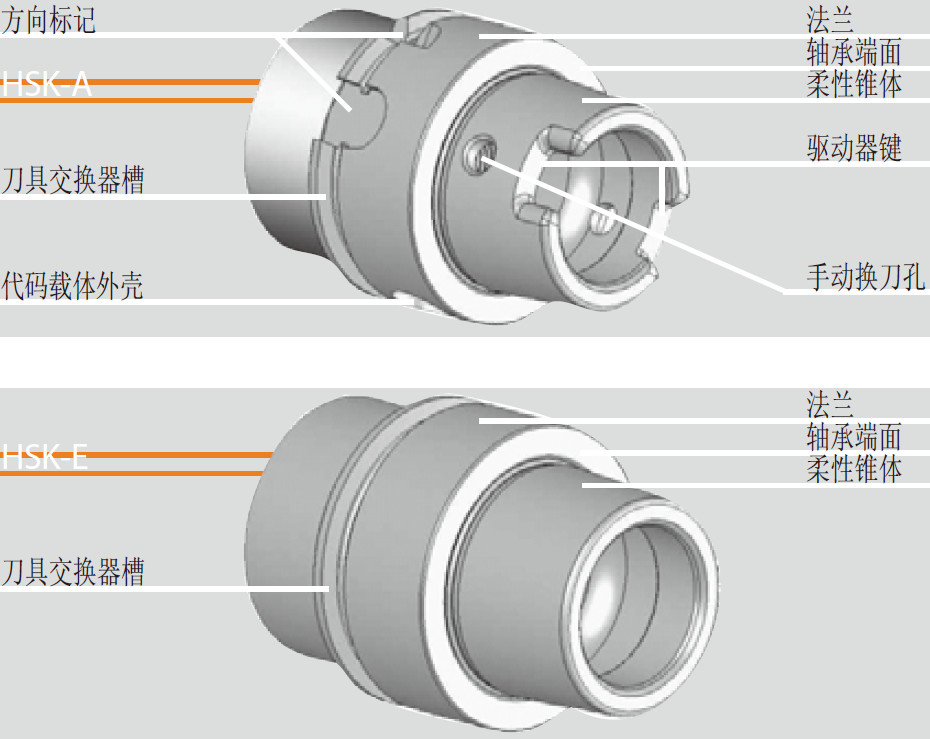
Due to the high spindle speed required in HSM machining, it is best to use HSK-A and HSK-E tool holder systems. Due to the installation of the knife holder flange on the spindle head, the knife holder has clear mechanical support in the Z direction, so it will not be dragged into the spindle due to increased centrifugal force at higher speeds.
The fundamental error may have occurred during the preparation stage of processing, making it impossible to achieve small vibrations and safe process control. To achieve stable HSM machining, it is crucial to balance the tool and tool holder device according to requirements and check their coaxiality. It is also necessary to consider the rotational speed limit related to the unbalanced mass.
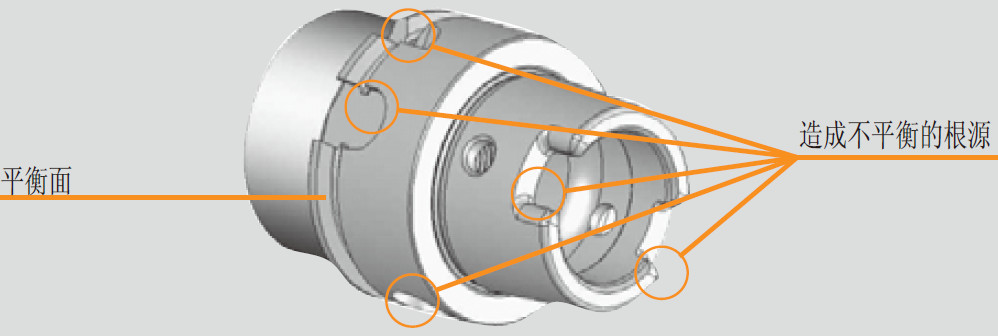
Unbalanced or non concentric rotating tool systems will result in:
1) Very poor surface quality
2) Very low tool life
3) Poor processing stability and safety
4) Possible damage to milling spindle
The imbalance and deviation from ideal concentricity caused by sudden changes during the processing are clearly shown in the schematic diagram below:
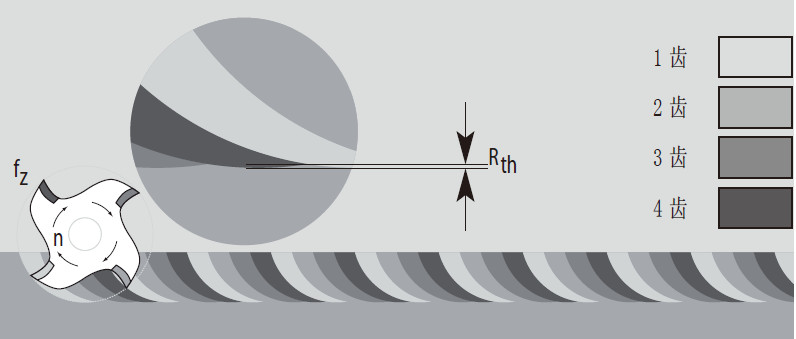
No deviation compared to perfect concentricity: smaller theoretical roughness
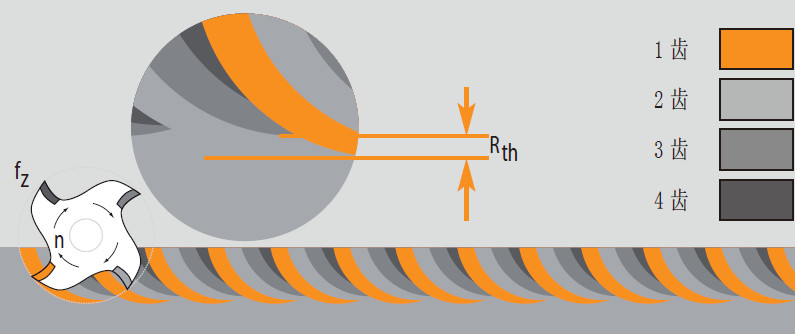
Deviation from perfect concentricity: larger theoretical roughness
The balanced mass has a significant impact on the dynamic performance of the entire rotating system.
Imbalance is equivalent to having an eccentric object rotating. This eccentric object can cause centrifugal force, which increases with the square value of the rotational speed. This means that the centrifugal force caused by the same imbalance on a spindle with a speed of 42000 rpm is 441 times that of a spindle with a speed of 2000 rpm (212=441). Therefore, the imbalance of the tool holder device in high-speed machining has particularly obvious adverse consequences.
By applying the tool clamping technology in HSM, you can use the tool holder with the following items:
Chuck
Reducing joint
It is not recommended to use alternative systems such as Weldon connectors as they have obvious defects in HSM processing.
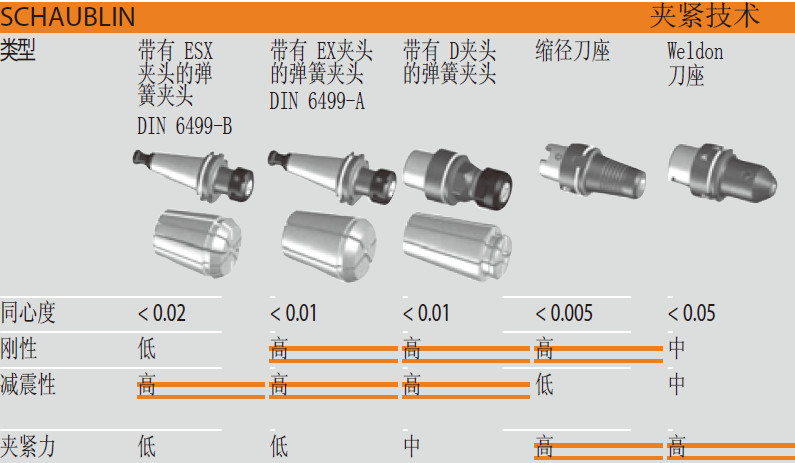
Due to the excellent damping characteristics of the tool holder with a chuck, it can bring good results to the rough machining process. Therefore, together with the reduced diameter joint, it can achieve extremely high rigidity and repeatability accuracy. This is crucial for obtaining a perfect workpiece surface. The use of reduced diameter joints allows you to achieve very precise concentricity (deviation less than 0.003 mm) and significant torque transmission.
The design structure of various reduced diameter tool holders: the transmission of torque depends on the design structure of the clamping equipment; The design structures may vary greatly.