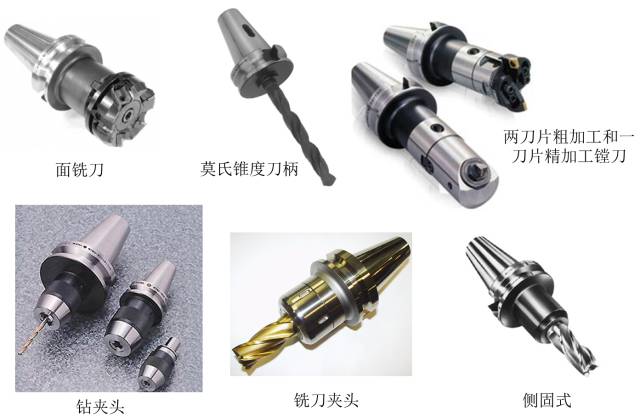
Do you know how many different tool handles there are in CNC machining centers?
Although I deal with knife handles every day, do you know what 7:24 in BT knife handles means? What are the standards for BT, NT, JT, IT, and CAT? Today, let's talk about the knowledge of machining center tool holders.
The tool holder is the connecting body between the machine tool and the cutting tool, and it is a key link that affects concentricity and dynamic balance. It should not be regarded as a general component. Concentricity can determine whether the cutting amount of each cutting edge part is uniform when the tool rotates for one revolution; Dynamic imbalance during spindle rotation will generate periodic vibrations.
one
Divided into two categories based on the spindle taper hole
According to the taper of the spindle tool hole in the machining center, it is usually divided into two categories:
1) SK universal tool holder with a taper of 7:24
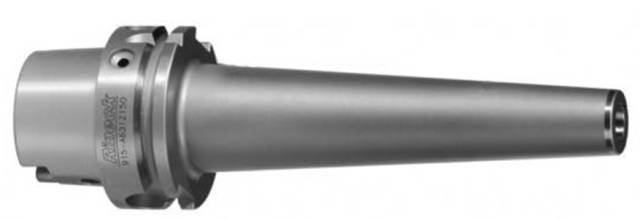
2) HSK vacuum tool holder with a taper of 1:10
SK universal tool holder with a taper of 7:24
7:24 refers to a taper of 7:24 for the tool handle, which is a separate conical surface positioning and has a longer taper handle. The surface of the cone plays two important roles simultaneously, namely precise positioning of the tool holder relative to the spindle and achieving tool holder clamping.
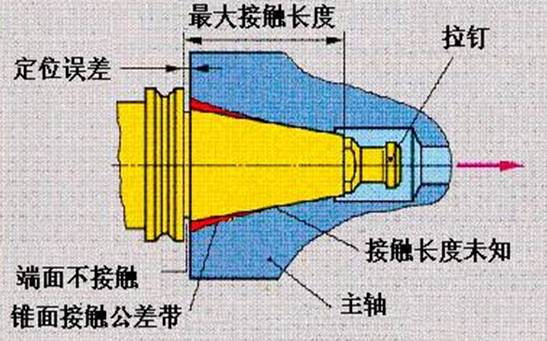
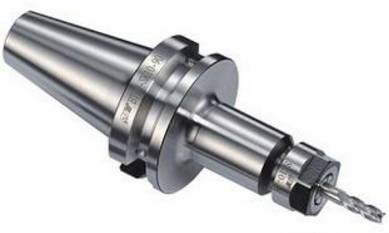
Advantages:
Not self-locking, can achieve fast tool loading and unloading; The manufacturing of tool holders only requires high-precision machining of the cone angle to ensure the accuracy of the connection, so the cost of tool holders is relatively low.
Disadvantages:
When rotating at high speed, the taper hole at the front end of the spindle will expand, and the magnitude of the expansion will increase with the increase of the rotation radius and speed. The stiffness of the taper connection will decrease, and under the action of the pull rod tension, the axial displacement of the tool handle will also change. The radial size of the tool holder changes every time the tool is changed, resulting in unstable precision in repeated positioning.
There are usually five standards and specifications for universal tool holders with a taper of 7:24:
1) International standard IS0 7388/1 (referred to as IV or IT)
2) Japanese Standard MAS BT (abbreviated as BT)
3) German standard DIN 2080 type (abbreviated as NT or ST)
4) American Standard ANSI/ASME (abbreviated as CAT)
5) DIN 69871 type (abbreviated as JT, DIN, DAT or DV)
Tightening method:
The NT type tool handle is tightened by a pull rod on traditional machine tools, also known as ST in China; The other four types of tool holders are all tightened on the machining center through the pull pins at the end of the tool holder.
Universality:
1) Currently, the two most commonly used tool holders in China are DIN 69871 (i.e. JT) and Japanese MAS BT;
2) The tool holder of DIN 69871 can also be installed on machine tools with ANSI/ASME spindle taper holes;
3) The international standard IS0 7388/1 tool holder can also be installed on machine tools with DIN 69871 and ANSI/ASME spindle taper holes, so in terms of universality, the IS0 7388/1 tool holder is the best.
HSK vacuum tool holder with a taper of 1:10
The HSK vacuum tool holder relies on the elastic deformation of the tool holder, which not only contacts the 1:10 conical surface of the tool holder with the 1:10 conical surface of the machine tool spindle hole, but also tightly contacts the flange surface of the tool holder with the spindle surface. This double-sided contact system is superior to the 7:24 universal tool holder in high-speed machining, connection rigidity, and coincidence accuracy.
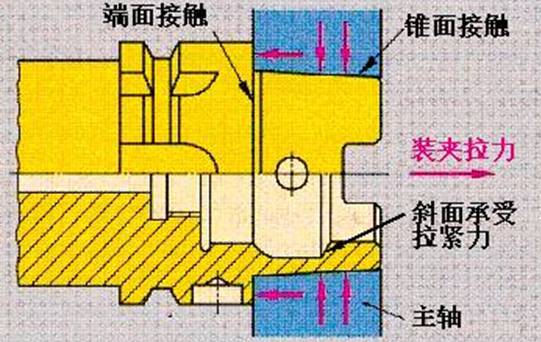
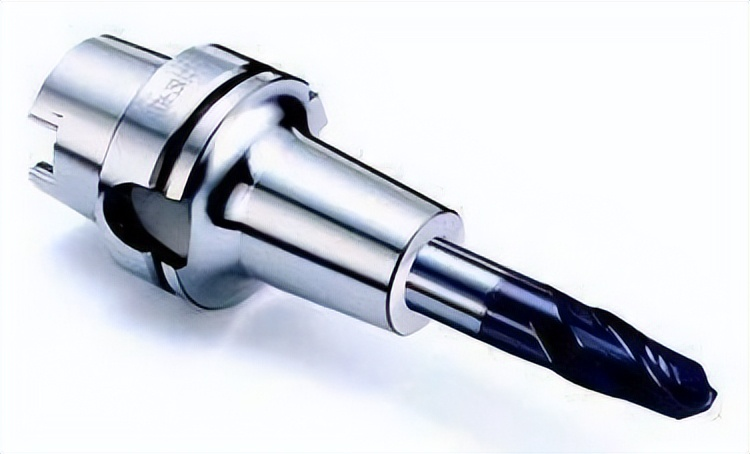
HSK vacuum tool holders can improve the rigidity and stability of the system, as well as the product accuracy during high-speed machining, and shorten the time for tool replacement. They play an important role in high-speed machining, adapting to machine tool spindle speeds of up to 60000 revolutions per minute. The HSK tool system is widely used in manufacturing industries such as aerospace, automotive, and precision molds.
HSK tool holders come in various specifications such as A, B, C, D, E, and F, among which A, E, and F are commonly used on machining centers (automatic tool changing).
The biggest difference between Type A and Type E:
1) A type has a transmission groove while E type does not. So relatively speaking, Type A has a larger transmission torque and can be used for some heavy cutting. The torque transmitted by the E-type is relatively small, and can only be used for some light cutting.
2) In addition to the transmission groove, the A-type handle also has manual fixing holes, directional grooves, etc., so the balance is relatively poor. And the E-type does not, so the E-type is more suitable for high-speed machining. The mechanisms of E-type and F-type are completely identical, with the difference being that the cone of the F-type handle, also known as the E-type and F-type handle (such as E63 and F63), is one size smaller. That is to say, the flange diameters of E63 and F63 are both φ 63, but the cone size of F63 is only the same as that of E50. So compared to E63, F63 has a faster speed (smaller spindle bearings).
two
The installation form of the handle
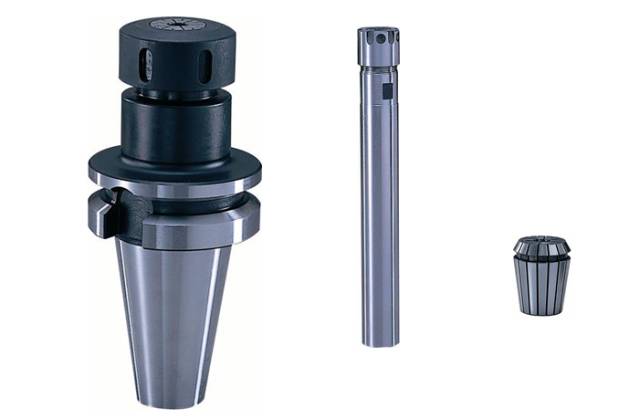
Spring chuck handle
Mainly used for clamping straight shank cutting tools and tools such as drill bits, milling cutters, taps, etc. The elastic deformation of the retaining spring is 1mm, and the clamping range is within a diameter of 0.5-32mm.
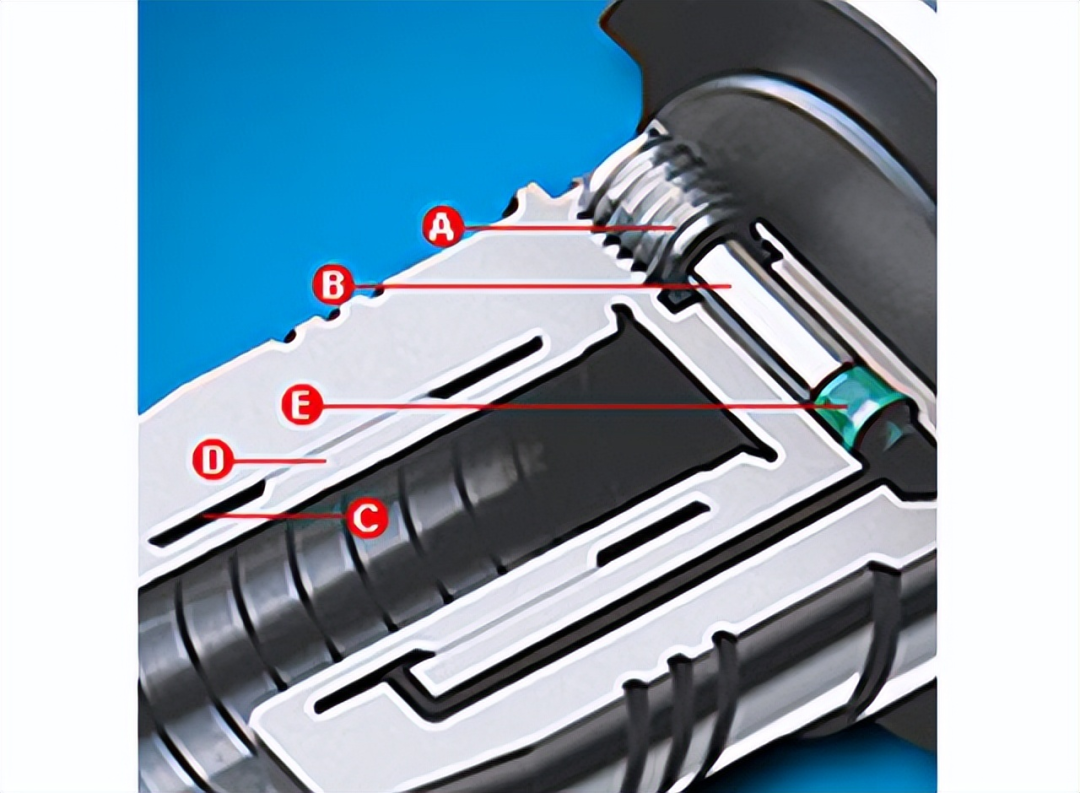
Hydraulic chuck
A - Tighten the locking screw using an Allen wrench;
B - Lock the piston and press the hydraulic medium into the expansion chamber;
C - Expansion chamber, pressure generated by liquid compression;
D - Thin expansion liner, which locates and evenly envelops the center of the tool clamping rod during the locking process.
E - Special sealing components ensure ideal sealing and long service life.
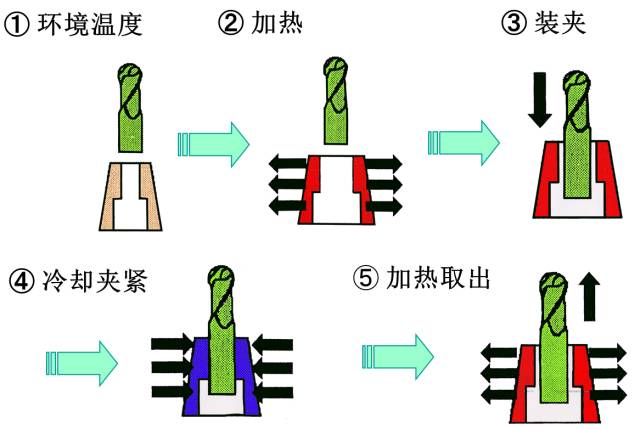
Heating knife handle
Apply induction heating technology to heat the tool clamping area on the tool holder, causing its diameter to expand, and then place the cold tool holder into the hot tool holder. The heating tool holder has a strong clamping force and good dynamic balance, making it suitable for high-speed machining. High precision in repeated positioning, generally within 2 μ Within m, radial runout is within 5 μ Within m; Good anti fouling ability and anti interference ability during processing. However, each specification of tool holder is only suitable for installing a tool with one diameter, and a set of heating equipment is required.
Principle of clamping for heat shrink tool holders:
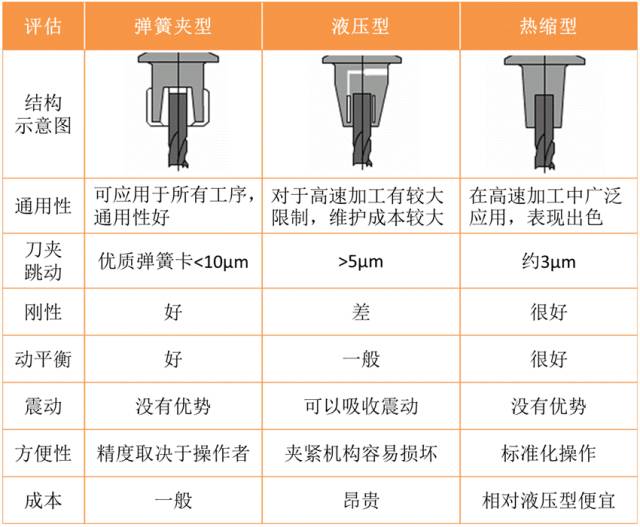
Comprehensive evaluation and comparison of knife handles:
Other types of knife handles