


Why can't gears have less than 17 teeth, what if they are missing?
Gear is a widely used spare part in daily life, whether it is used in aviation, cargo ships, automobiles, and so on. However, when designing and processing gears, there are requirements for the number of gears. Some people say that if it is less than 17 teeth, it cannot rotate, while others argue that it is not correct. Gears with less than 17 teeth are everywhere, and everyone's statement is correct. Do you know why?
Why is it 17? And not other numbers? As for 17, it starts with the machining method of gears, as shown in the figure below. One widely used method is to use a hob to cut.
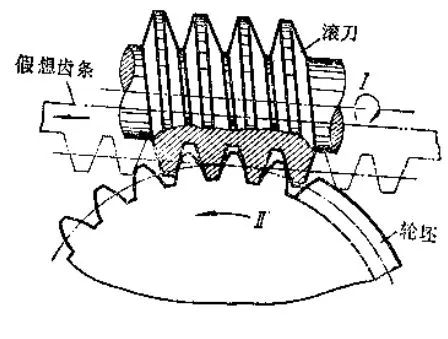
When manufacturing gears in this way, when the number of teeth is small, root cutting will occur, which will affect the strength of the manufactured gears. What is root cutting, it means that the root has been cut... Pay attention to the red box in the figure:
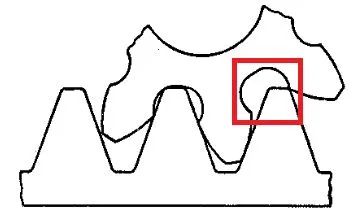
When the intersection point between the tooth tip of the gear and the meshing line exceeds the limit meshing point of the gear being cut, a part of the involute tooth profile of the tooth root of the gear being cut is cut off, which is called root cutting.
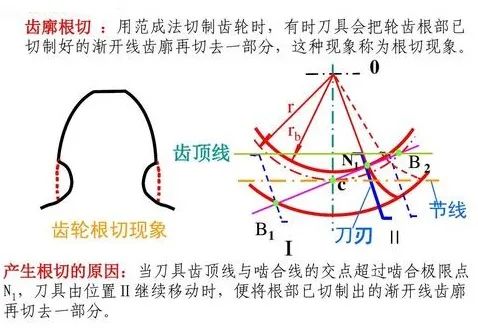
So under what circumstances can root cutting be avoided? The answer is this 17 (when the tooth top height coefficient is 1 and the pressure angle is 20 degrees).
Firstly, the gear can rotate because a good transmission relationship needs to be formed between the upper gear and the lower gear. Only when the connection between the two is in place, can its operation be a smooth relationship. Taking involute gears as an example, only when two gears mesh well can they play their role, which can be further divided into two types: spur cylindrical gears and helical cylindrical gears.
A standard spur gear has a coefficient of one for tooth top height and 1.25 for tooth heel height, and its pressure angle should reach 20 degrees. When machining gears, if there are two gears between the tooth blank and the tool, it will look like two gears.
If the number of teeth in the embryo is less than a specific value, a part of the root of the tooth will be excavated, which is called root cutting. If the root cutting is too small, it will affect the strength and stability of the gear. The 17 mentioned here are for gears. If we don't talk about the working efficiency of gears, they will work and run regardless of how many teeth they have.
In addition, 17 is a prime number, which means that one tooth of a gear has the least number of coincidences with another gear at a certain number of turns, so it will not remain at this point for a long time when subjected to force. Gears belong to precision instruments. Although errors may occur on each gear, the probability of axle wear caused by 17 is too high. Therefore, if it is 17, it is okay to move for a while in the short term, but not in the long term.
But here comes the problem! There are still many gears on the market with less than 17 teeth, which still rotate well. There are pictures and truths!
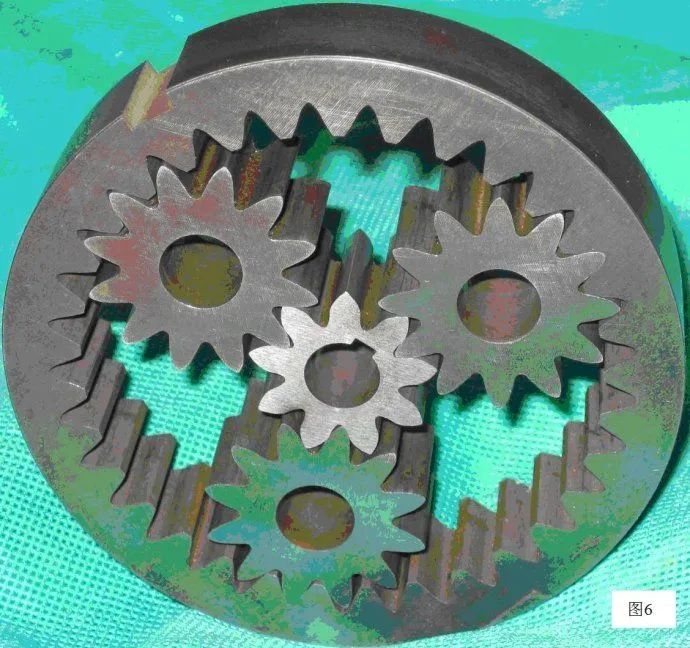
Some netizens pointed out that in fact, if a different processing method is used, it is possible to manufacture standard involute gears with fewer than 17 teeth. Of course, such gears are also very easy to get stuck when used (due to gear interference, the image cannot be found, please think carefully), so they really cannot rotate. There are also many corresponding solutions, among which the modified gear is the most commonly used one (in layman's terms, the cutting tool is moved a bit away during cutting), and there can also be helical gears, cycloidal gears, and so on. Another thing is the cycloidal gear.
Another netizen's point of view: It seems that people still believe too much in books. I don't know how many people have thoroughly studied gears in their work. In the course of Mechanical Principles, the derivation of the principle that involute spur gears with more than 17 teeth do not produce root cutting is based on the fact that the top fillet R of the front cutting surface of the rack tool for machining gears is 0. However, in reality, how can industrial production tools not have an R angle? The heat treatment of cutting tools without R-angle is prone to stress concentration and cracking in sharp parts, which can cause wear or cracking during use. Moreover, even if the tool does not have R-angle root cutting, the maximum number of teeth that can occur may not be 17 teeth. Therefore, the statement that 17 teeth is a root cutting condition is actually open to debate! Let's take a look at the above pictures.
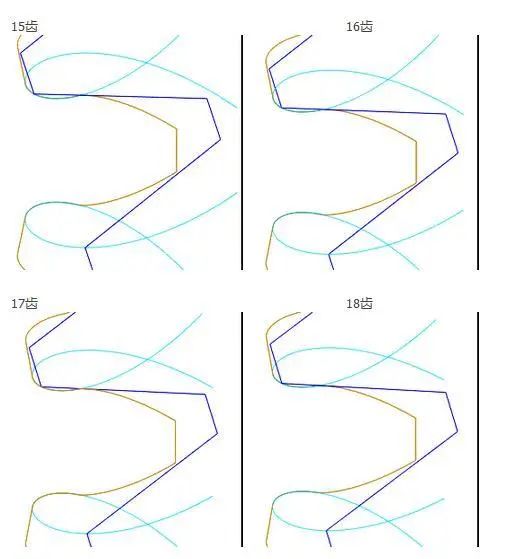
From the graph, it can be seen that there is no significant change in the tooth root transition curve from 15 to 18 teeth when machining gears with a tool with a top R angle of 0 on the rake face. So why is it said that 17 teeth are the number of teeth that begin to undergo root cutting as involute straight teeth?
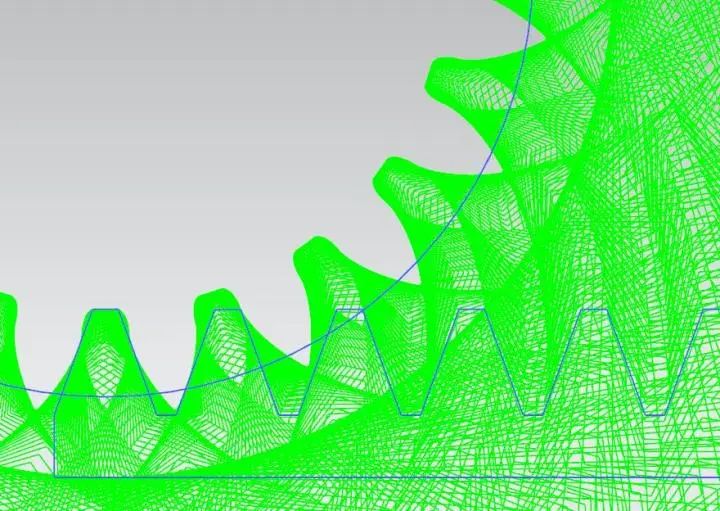
This picture must have been drawn by students majoring in mechanical engineering using a gear generator, and it can be seen that the size of the tool's R angle affects the gear root cutting.
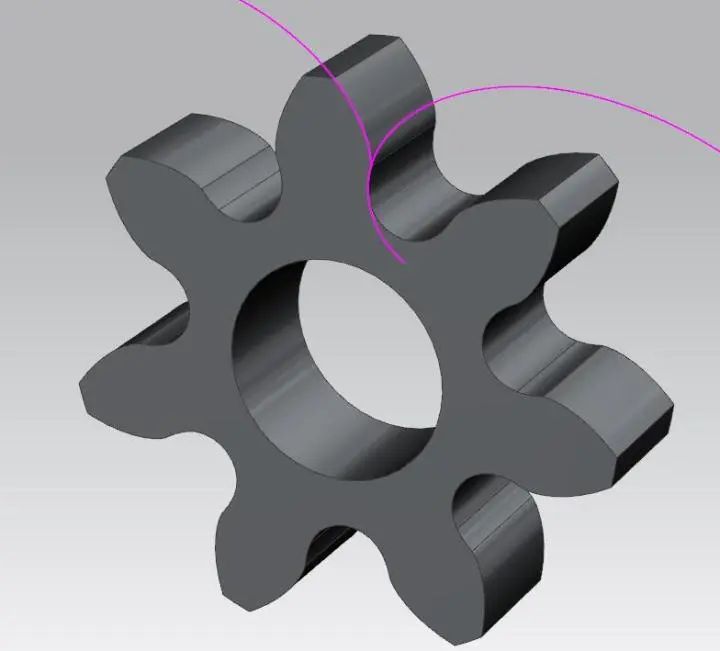
The equidistant curve of the purple extended epicycloid at the root of the tooth in the above figure is the tooth profile after root cutting. To what extent will the root of a gear be cut and affect its use? This is determined by the relative motion of the tooth tip of another gear and the strength reserve of the tooth root of the gear. If the tooth tip of the paired gear does not mesh with the root cut part, then these two gears can rotate normally.

From this graph, it can be seen that the meshing lines of these two gears just rub against the maximum diameter circle of the transition curve of the two gears (note: the purple part is the involute tooth profile, the yellow part is the root cut part, and the meshing line cannot enter below the base circle because there is no involute below the base circle, and the meshing points of the two gears at any position are on this line), which means that these two gears can just mesh normally, Of course, this is not allowed in engineering. The length of the meshing line is 142.2, and this value/base node=overlap.
Some people also say that this question is incorrect. A gear with less than 17 teeth will not affect its use (the description of this point in the first answer is incorrect, and the three conditions for correct gear meshing are not related to the number of teeth). However, 17 teeth may cause inconvenience in processing in certain specific situations. Here, more information about gears will be added.
Let's first talk about involute, which is the most widely used type of gear tooth profile. So why is it an involute? What is the difference between this line and straight lines and arcs? As shown in the figure below, it is an involute (here there is only a half tooth involute).
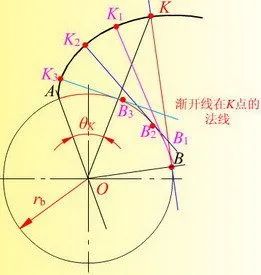
In other words, an involute is the trajectory traveled by a fixed point on a line as it rolls along a circle. Its benefits are obvious, as shown in the following figure when two involutes mesh with each other.
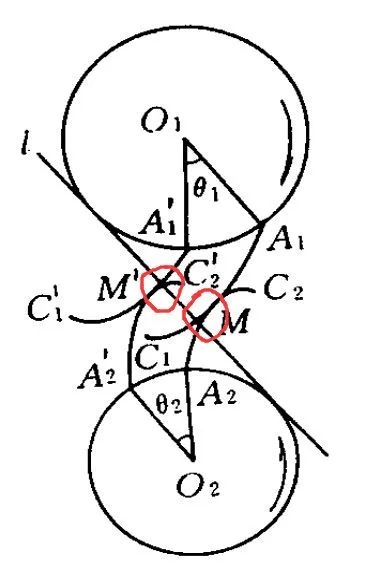
When two wheels rotate, the direction of force acting on the contact point (such as M, M ') is always on the same straight line, and this straight line is perpendicular to the contact surface (section) of the two involute lines. Due to its perpendicularity, there will be no "slip" or "friction" between them, which objectively reduces the friction force of gear meshing, not only improving efficiency but also extending the service life of the gear.
Of course, as the most widely used form of tooth profile - involute, it is not our only choice.
Speaking of "root cutting", as engineers, we not only need to consider whether the theoretical level is feasible and the effect is good, but more importantly, we need to find ways to present the theoretical things, which involves material selection, manufacturing, accuracy, testing and other aspects.
The commonly used machining methods for gears are generally divided into forming method and template method. Forming method refers to directly cutting the tooth shape by manufacturing a tool corresponding to the gap shape between the teeth, which generally includes milling cutters, butterfly grinding wheels, etc; The method of meshing is quite complex, which can be understood as two gears meshing, one of which is very hard (cutting tool), and the other is still in a rough state. The process of meshing gradually moves from being far away to a normal meshing state, and in this process, cutting produces new gears. Interested parties can refer to "Mechanical Principles" for specific learning.
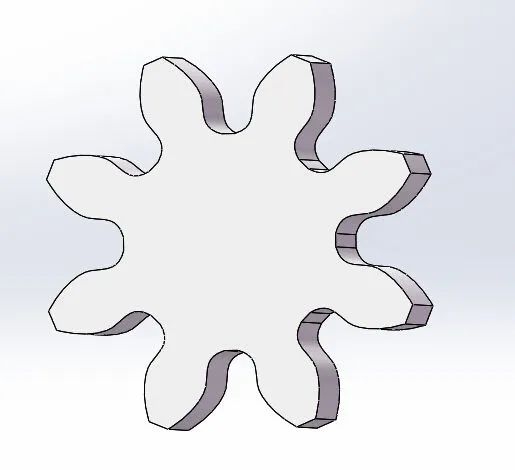
The use of the norm method is very widespread, but when the number of teeth in the gear is small, the intersection point between the tooth top line of the tool and the meshing line will occur, exceeding the meshing limit point of the gear to be cut. At this time, the root of the gear to be machined will be cut too much. Since the cut part exceeds the meshing limit point, it does not affect the normal meshing of the gear, but the disadvantage of this is that it weakens the strength of the gear teeth, When such gears are used in heavy-duty situations such as transmissions, they are prone to tooth breakage, as shown in the picture of a 2-mode 8-tooth gear model after normal machining (with root cutting).
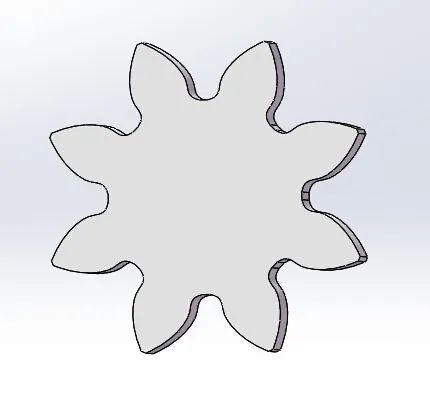
And 17 is the limit number of teeth calculated under the gear standard in China. Gears with less than 17 teeth will experience "root cutting" phenomenon during normal machining using the generative method. At this time, the machining method needs to be adjusted, such as displacement, as shown in the figure for a 2-mode 8-tooth gear (small root cutting) with displacement machining.
Of course, many of the contents described here are not comprehensive. There are also many more interesting parts in machinery, and manufacturing these parts in engineering also faces more problems. Interested readers may want to pay more attention.
Conclusion: The 17 teeth come from the machining method and also depend on the machining method. If the machining method of the gear is replaced or improved, such as forming method or displacement machining (specifically referring to spur cylindrical gears), there will be no undercutting phenomenon, and there will be no limit on the number of 17 teeth.
Furthermore, from this question and its answer, it can be seen that a characteristic of the mechanical discipline is the high degree of integration between theory and practice.
Viewpoint from the Mechanical Hydraulic Forum: Firstly, the statement that gears cannot rotate with less than 17 teeth is incorrect. Below, we will briefly introduce how the number 17 teeth is derived.

A gear refers to a mechanical component on the rim of a wheel that continuously meshes with gears to transmit motion and power. The tooth profile of a gear can be involute, arc-shaped, etc., and involute gears are widely used.
Involute gears are further divided into spur cylindrical gears/helical cylindrical gears, etc. For standard spur cylindrical gears, the tooth top height coefficient is 1, the tooth root height coefficient is 1.25, and the pressure angle is 20 °. When machining gears, the generative method is generally used, which means that the motion of the cutting tool and the gear blank during machining is like a pair of meshing gears. For standard gear machining, if the number of teeth is less than a specific value, a part of the involute profile at the root of the gear blank will be excavated, which is called root cutting. As shown in the left figure, root cutting will seriously affect the strength and smoothness of the gear transmission. The minimum value without root cutting is 2 * 1/sin (20) ^ 2 (1 is the tooth top height coefficient, and 20 is the pressure angle).
The 17 teeth here are for standard spur cylindrical gears, and we have many ways to avoid undercutting, such as gear displacement, which means the tool is away from or near the center of rotation of the wheel blank. To avoid undercutting, it is necessary to choose to be away from the center of rotation of the contour. As shown in the figure on the right, is the complete involute contour line coming out again.
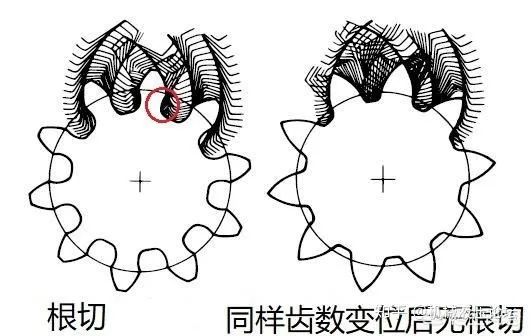
After the gear is modified, the gear can rotate again without being affected, and with appropriate modification, a 5-tooth gear can also rotate.
In fact, helical gears can also avoid gear undercutting or reduce the minimum tooth value at which undercutting occurs.
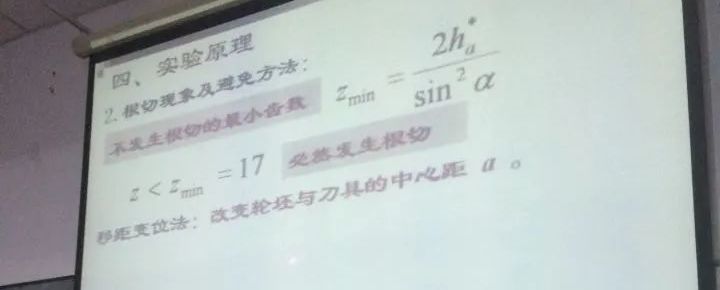
The number 17 is calculated. It is not that a few 17 gears cannot rotate, but if there are less than 17 teeth, it is easy to cut off a part of the gear root with the machined clearance line during gear machining, which is called root cutting, causing a decrease in gear strength. As for how to calculate it, it is entirely a mathematical problem. Referring to the formula above, the pinch angle a=20 degrees, and the minimum number of teeth that do not undergo root cutting is 17.
Netizen's viewpoint: Whether the number of teeth in a gear can be less than 17 is a question worth considering. For standard gears, the number of teeth really cannot be less than 17, why. Because when the number of teeth is less than 17, the gear will experience undercutting.
The so-called root cutting refers to the cutting of the involute tooth profile of the tooth root by cutting too much of the tooth tip of the cutting tool into the root of the gear tooth under certain conditions when cutting teeth using the generative method.
generating method
The generative method (also known as the generative method) is a method of machining gears using the envelope principle in geometry. After giving the involute tooth profile of two gears and the angular velocity w1 of the driving wheel, the angular velocity w2 of the driven wheel can be obtained by meshing the two tooth profiles, and i12=w1/w2=a constant value. Because in the meshing of two tooth profiles, the two pitch circles undergo pure rolling. During the pure rolling process of pitch circle 1 on pitch circle 2, the tooth profile of gear 1 will occupy a series of relative positions with respect to gear 2, and the envelope of this series of relative positions is the tooth profile of gear 2. That is to say, when the two pitch circles undergo pure rolling, the two involute tooth profiles can be regarded as mutually enveloping lines.
Root cutting phenomenon
The reason for root cutting: When the intersection point of the tool tooth crest line and the meshing line exceeds the meshing limit point N1, and the tool continues to move from position II, a part of the already cut involute tooth profile at the root is cut off.
The consequences of root cutting: gears with severe root cutting, on the one hand, weaken the bending strength of the teeth; On the other hand, it will reduce the fit of the gear transmission, which is very detrimental to the transmission. The reason for root cutting: When the intersection point of the tool tooth crest line and the meshing line exceeds the meshing limit point N1, and the tool continues to move from position II, a part of the already cut involute tooth profile at the root is cut off.
For non-standard gears, having fewer than 17 teeth is acceptable.


