


How much do you really know about thread milling cutters?
one
Processing stability
When processing difficult to machine materials such as titanium alloys, high-temperature alloys, and high hardness materials, the tap often twists or even breaks in the part due to excessive cutting force. In the processing of long chip materials, once the chip removal is not smooth, the chips will wrap around the tap or block the hole, often causing the tap to break or break in the part. Removing a broken tap is not only time-consuming and laborious, but may also damage the parts. To solve this problem, we can use a thread milling cutter. Due to the fact that the thread milling cutter gradually cuts into the material, it generates less cutting force and rarely breaks, resulting in powder like chips. Even in the event of a broken blade, due to the much smaller diameter of the milling cutter than the threaded hole, the broken part can be easily removed from the part without damaging it.
two
Diversification of processed materials
Excellent cutting conditions enable thread milling cutters to process a wide range of materials, even high hardness steels such as HRC65 °, titanium alloys, and nickel based alloys can be easily machined. When processing difficult to machine materials, thread milling provides a convenient way to process threads, otherwise using tapping will be difficult to machine.
three
High precision in thread machining
Thread milling is mostly high-speed and efficient cutting, with powder chips and no entanglement. Therefore, both the machining accuracy and surface smoothness are far higher than other thread processing methods. Because thread milling is achieved through high-speed rotation of the cutting tool and spindle interpolation to facilitate the removal of internal thread chips. Milling threads belongs to chip cutting, with short chips. In addition, the diameter of the machining tool is smaller than that of the machining thread, which can avoid the rotation line formed by the reversal of the tap (not allowed in situations with high sealing requirements). Because the original milling cutter does not have a turning line, and the tap cannot be avoided. The phenomenon of not easily forming sticky chips. For relatively soft materials, chip sticking is prone to occur during the processing, but threads require low machine power. Because thread milling is chip breaking cutting, the tool contacts locally and is subjected to small cutting forces, while the tap tool is easy to handle when damaged.
four
Widely applicable
The same tool can be used for right/left thread machining. As long as the pitch is the same, threads of different diameters can be manufactured using the same tool. The same thread milling cutter can be used for blind holes and through holes. W. BSPT, PG, NPT, NPTF, and NPSF can use the same thread milling cutter for both external and internal threads.
PS: In our daily work, we will face different thread specifications. Later, we will summarize the relative taps of various threads for everyone. Please stay tuned.
five
The advantages of processing blind holes
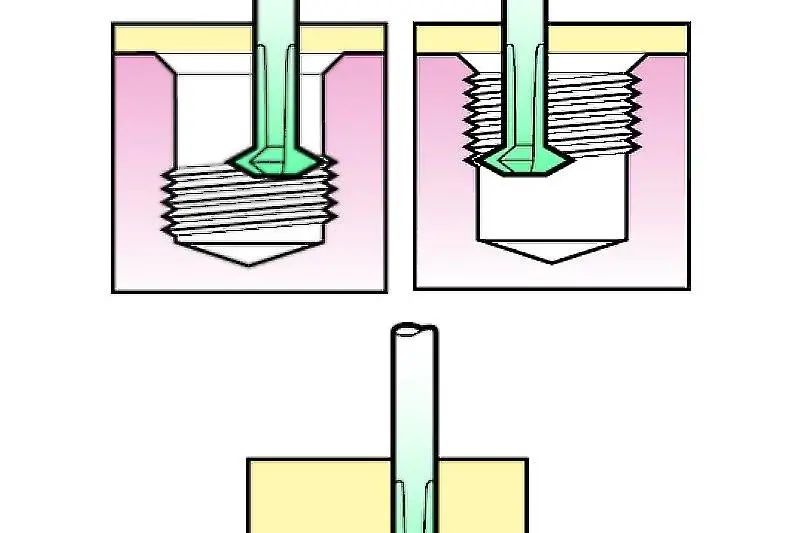
Processing blind holes: When milling threads, you will obtain a complete thread contour to the bottom of the hole. When tapping, it is necessary to drill deeper because the tap cannot form a complete thread contour until the third thread. Therefore, with a thread milling cutter, you don't need to consider changing the structure to deepen the hole.
six
Reduce spindle loss of machine tools
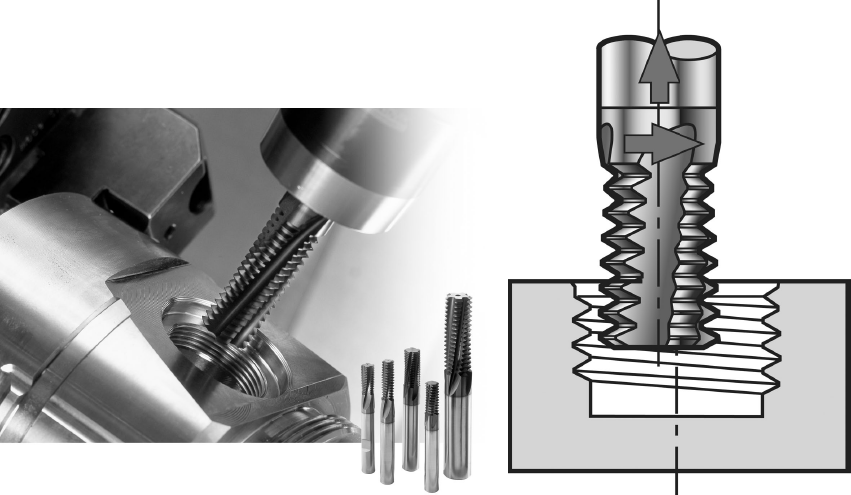
Compared with using taps for thread machining, thread milling does not require emergency stops and reversals at the bottom of the spindle, greatly improving the service life of the machine tool spindle.
seven
High processing efficiency
We know that in large-scale thread machining, it is very difficult to improve machining efficiency due to the low cutting speed limit of the tap and the reverse tool retraction after machining the thread. However, if we use a thread milling cutter, not only does it have a high milling speed, but its multi groove design increases the number of cutting edges, making it easy to increase the feed rate, which can greatly improve machining efficiency. In the processing of long threads, we can also choose blades with longer blades to reduce the axial feed distance (equivalent to shortening the thread) to further improve processing efficiency;
eight
Deburring effect
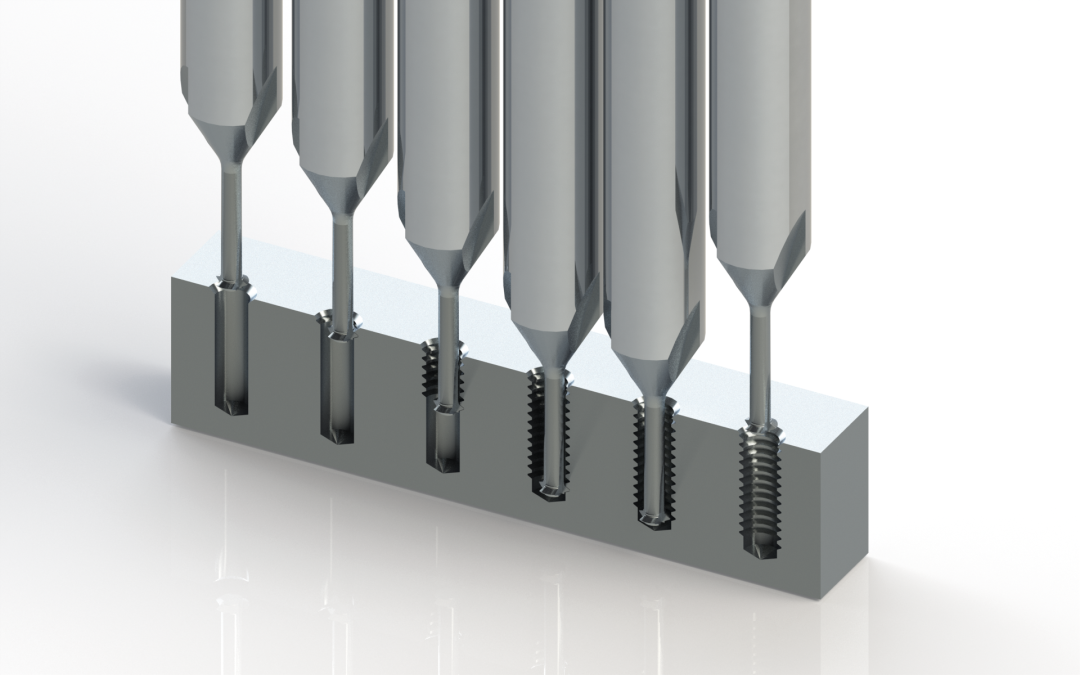
Some brands of thread milling cutters complete thread processing and deburring in one go. No need to spend more time on deburring, while saving labor costs.
nine
Low processing cost
The thread milling cutter is flexible to use and can be suitable for various working conditions.
For example, we can use the same thread milling cutter to machine left-hand threads or right-hand threads; It can process both external and internal threads. All of this just requires adjusting the interpolation program. Using a tap for machining, if there are multiple threaded holes with different diameters but the same pitch on the part, different diameter taps are required. This not only requires a large number of taps, but also takes a longer time to change the tool.
If a thread milling cutter is used, as it uses spiral interpolation for machining, only changing the machining program can complete the machining of all diameter threads, greatly saving tool costs and tool changing time. To ensure thread accuracy, different types of taps are required when machining different materials with taps. However, there is no such limitation when using a thread milling cutter.
The same thread milling cutter can process the vast majority of materials and achieve high-precision threads. This can also greatly reduce tool costs. When machining threads close to the bottom of blind holes, it will be difficult to obtain a complete thread at the bottom if a tap is used. And it is possible that during the time when the bottom tap stops and is ready to reverse and retreat, the tool will continue to move forward a little distance (floating tapping), which can easily cause the tap to break.
By using a thread milling cutter, this problem can be avoided - the thread milling cutter is smaller than the hole and does not need to reverse the cutter, while still maintaining the complete thread shape at the tool tip. This way we can obtain a complete and accurate thread depth! In some machining processes, thread milling can help us solve many problems.
For example, in the thread machining of large, non circular parts, complex clamping and balancing are required to avoid vibration when machining on a lathe. At this point, machining can be carried out on the machining center, with the parts stationary and the thread milling cutter rotating to avoid balance issues. For example, when processing intermittent threads, vibration and impact have a significant impact on the blade and are prone to cracking. The use of thread milling cutters avoids large impacts and extends the tool life as the tool gradually cuts into material discontinuities.


