


Complete collection of CNC lathe processing techniques!
Numerical control lathe is a high-precision and high-efficiency automated machine tool. The use of numerical control lathe can improve machining efficiency and create more value. The emergence of numerical control lathe has freed enterprises from outdated machining technology. The machining process of numerical control lathe is similar to that of ordinary lathe. However, due to the fact that numerical control lathe is a one-time clamping, continuous automatic machining completes all turning processes, the following aspects should be noted.
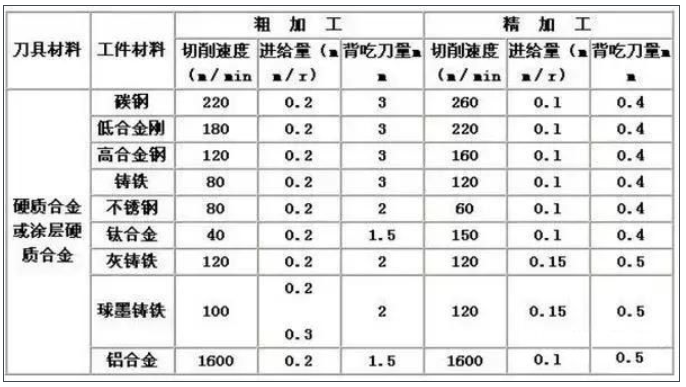
Reasonable selection of cutting parameters is crucial for efficient metal cutting, as the material being processed, cutting tools, and cutting conditions are the three main factors. These determine processing time, tool life, and processing quality. The economically effective processing method is inevitably the rational selection of cutting conditions.
The three elements of cutting conditions: cutting speed, feed rate, and cutting depth directly cause tool damage. With the increase of cutting speed, the temperature of the tool tip will rise, resulting in mechanical, chemical, and thermal wear. By increasing the cutting speed by 20%, the tool life will be reduced by half.
The relationship between feed conditions and wear behind the tool occurs within a very small range. But with a large feed rate, the cutting temperature rises, leading to significant wear afterwards. It has less impact on the tool than cutting speed. The influence of cutting depth on the tool is not as significant as that of cutting speed and feed rate, but in small cutting depths, the material being cut produces a hardened layer, which also affects the tool's lifespan.
Users need to choose the cutting speed to use based on the material being processed, hardness, cutting status, material type, feed rate, cutting depth, etc. The selection of the most suitable processing conditions is based on these factors. Regular and stable wear is the ideal condition for achieving lifespan.
However, in practical operations, the selection of tool life is related to tool wear, changes in the processed size, surface quality, cutting noise, processing heat, and so on. When determining the processing conditions, it is necessary to conduct research based on the actual situation. For difficult to machine materials such as stainless steel and heat-resistant alloys, coolants or rigid cutting edges can be used.
How to determine the three elements of cutting machining and how to choose them correctly is a main content of the course on metal cutting principles. Some key points have been excerpted on Metal Processing WeChat, and the basic principles for selecting these three elements are as follows:
1) To choose the spindle speed per minute (linear speed, circumferential speed) V (meters/minute), it is necessary to first know how much the cutting linear speed V should be taken.
The selection of V depends on the tool material, workpiece material, processing conditions, etc. Cutting tool material: Hard alloy, V can achieve a higher value, usually above 100 meters per minute. Generally, when purchasing blades, technical parameters are provided: what material can be processed and how much linear speed can be selected.
High speed steel: V can only achieve a lower value, generally not exceeding 70 meters per minute, and in most cases, it is taken as below 20-30 meters per minute. Workpiece material: high hardness, low V value; Cast iron, with a lower value of V, can be used for cutting tools made of hard alloy, with a value of 70-80 meters per minute; Low carbon steel, V can be above 100 meters per minute, while for non-ferrous metals, V can be higher (100-200 meters per minute). Quenched steel, stainless steel, V should be taken lower. Processing conditions: rough machining, take a lower value for V; Precision machining, take a higher value for V. The rigidity system of machine tools, workpieces, and cutting tools is poor, and V is taken as low. If the CNC program uses S as the spindle speed per minute, then S should be calculated based on the workpiece diameter and the cutting line speed V: S (spindle speed per minute)=V (cutting line speed) * 1000/(3.1416 * workpiece diameter). If the CNC program uses a constant line speed, S can directly use the cutting line speed V (meters/minute)
2) The feed rate (feed rate) F mainly depends on the surface roughness requirements of the workpiece processing. When precision machining, the surface requirements are high, and the cutting amount is taken as small: 0.06-0.12mm/spindle per revolution. When rough machining, it is advisable to use a larger size.
It mainly depends on the strength of the cutting tool, generally taking 0.3 or above. When the main back angle of the cutting tool is large, the tool strength is poor, and the feed amount cannot be too large. In addition, the power of the machine tool and the rigidity of the workpiece and tool should also be considered. The CNC program uses two units of feed: mm/minute and mm/spindle per revolution. The units used above are mm/spindle per revolution. If mm/minute is used, the formula can be used to convert it: feed per minute=feed per revolution * spindle per minute
3) When precision machining, the cutting depth (cutting depth) is generally taken as less than 0.5 (radius value).
During rough machining, it is determined based on the condition of the workpiece, cutting tool, and machine tool. Generally, small lathes (with a maximum machining diameter of less than 400mm) turn 45 # steel in the normalized state, and the cutting depth in the radial direction generally does not exceed 5mm. Additionally, it should be noted that if the spindle speed of the lathe is controlled by ordinary variable frequency speed regulation, when the spindle speed is very low (below 100-200 rpm), the motor output power will significantly decrease, and at this time, the cutting depth and feed amount can only be achieved to a very small extent.
Reasonable selection of cutting tools
When rough turning, it is necessary to choose cutting tools with high strength and good durability to meet the requirements of large back cutting and large feed during rough turning.
When precision machining, it is necessary to choose cutting tools with high precision and good durability to ensure the required machining accuracy.
To reduce tool changing time and facilitate tool alignment, machine clamped knives and machine clamped blades should be used as much as possible.
Reasonable selection of fixtures
1. Try to use universal fixtures to clamp workpieces and avoid using specialized fixtures;
2. The part positioning reference coincides to reduce positioning errors.
Determining the machining route refers to the movement trajectory and direction of the tool relative to the part during the machining process of a CNC machine tool.
1. It should be able to ensure machining accuracy and surface roughness requirements;
2. The processing route should be shortened as much as possible to reduce the tool idle travel time. At present, the connection between machining route and machining allowance is not yet widely used in CNC lathes. Generally, excessive allowance on the blank, especially those containing forged or cast hard skin layers, should be arranged on ordinary lathes for processing.
If it is necessary to use a CNC lathe for machining, attention should be paid to the flexible arrangement of the program. The installation points of the fixture are currently achieved by connecting the hydraulic chuck and the hydraulic clamping cylinder through a pull rod. The clamping points of the hydraulic chuck are as follows: first, use a handle to remove the nut on the hydraulic cylinder, remove the pull tube, and pull it out from the rear end of the spindle. Then, use a handle to remove the fixing screws of the chuck, and the chuck can be removed.


